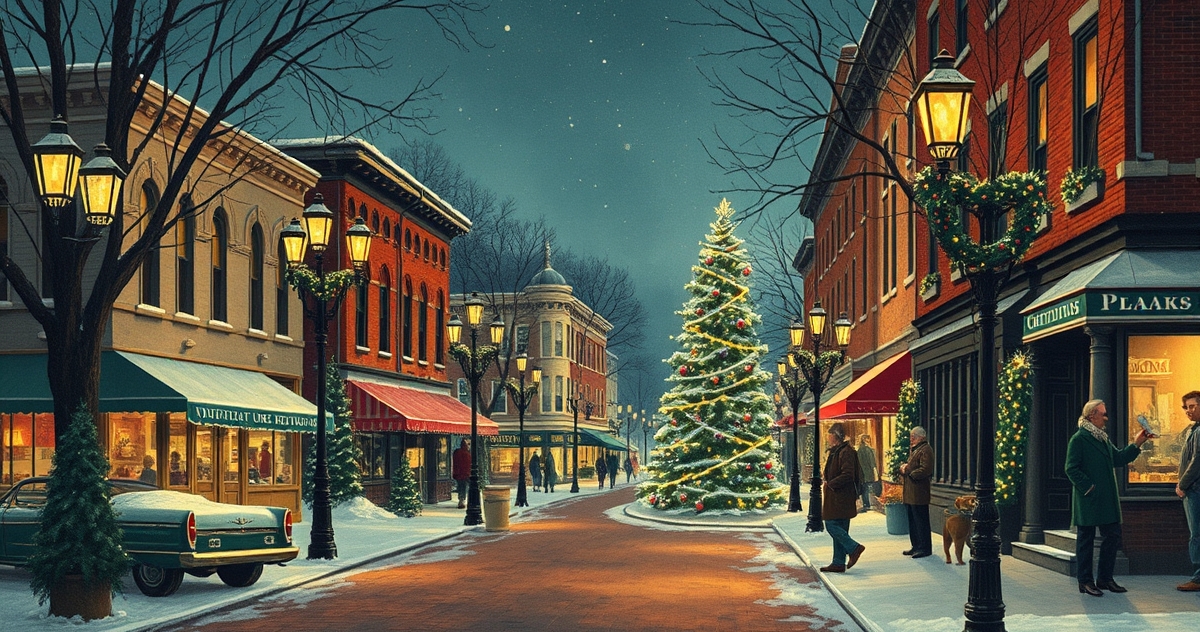
Picture a crisp December evening in a Connecticut town center. Snow dusts the historic gazebo. Families in heavy coats gather around a towering evergreen wrapped in warm white C9 bulbs, their amber glow reflecting off the frozen pond nearby. Children point upward, mouths open in wonder, while older residents quietly recall standing in this very same spot decades ago, looking up at the very same light. This is not nostalgia alone — it is living tradition, carried forward through generations, and it is as Connecticut as the stone walls that line our country roads.
The story of holiday lighting on Connecticut's town greens is a story of community identity, civic pride, and technological evolution. It begins with the earliest experiments in public electric illumination and continues today with energy-efficient LEDs that honor the spirit of those first glowing displays. Understanding this history helps us appreciate why these annual rituals matter so deeply — and why they deserve to be done right.
The New England Town Green: America's Original Gathering Place
Long before electricity, the town green was already the social and civic center of Connecticut life. Laid out by Puritan settlers in the 17th century, greens served as common grazing land, militia training grounds, and market squares. Towns like Litchfield, Madison, Woodbury, and New Milford developed greens that remain remarkably intact today, their broad lawns surrounded by churches, colonial-era storefronts, and municipal buildings that have changed little in two hundred years.
When electric lighting arrived in Connecticut's larger towns in the 1880s and 1890s, it was only a matter of time before civic leaders recognized its decorative potential. Early holiday lighting on town greens was modest by today's standards — a string of large incandescent bulbs along a fence line, a lit wreath on the town hall door, perhaps a single tree near the bandstand illuminated with the new electric candles that replaced dangerous wax tapers. But the impact on community morale was immediate and profound.
By the 1920s and 1930s, as electricity reached smaller Connecticut towns and the cost of electric lighting dropped, the annual ritual of decorating the town green for the holiday season became firmly established. Local civic organizations, merchant associations, and volunteer fire departments often led the effort, pooling resources to hang garlands along storefronts and string lights across the main thoroughfare. The town green was the anchor of it all.
The Golden Age of Connecticut Town Green Displays: 1940s–1980s
The mid-20th century was when Connecticut's town green holiday lighting truly came into its own. Following World War II, a spirit of communal celebration swept through American communities, and public holiday displays became an expression of civic optimism. Strings of large C7 and C9 bulbs — the classic ceramic-coated incandescent lamps that cast that unmistakable warm amber glow — became the standard vocabulary of public holiday decoration.
Towns invested in permanent infrastructure: mounting brackets on utility poles, electrical hookups near the gazebo, dedicated lighting budgets in the municipal calendar. The multicolor displays of the postwar era — reds, blues, greens, and yellows blazing against the winter sky — became the visual signature of Connecticut Christmases for an entire generation. Meanwhile, the garlands draped along fence posts and lamp poles added texture and depth, softening the geometry of streets and buildings with the suggestion of living greenery.
Notable displays emerged in communities across the state. The Litchfield green, one of the most photographed in New England, developed a lighting tradition that drew visitors from neighboring towns. The Madison town green earned a reputation for its tasteful, historically sensitive approach — warm white tones that complemented the Federal-style architecture lining the common. In Mystic, the combination of waterfront atmosphere and colonial-village aesthetics created a holiday lighting environment that felt like stepping into a 19th-century illustration.
These weren't just decorations. They were community events. The lighting ceremony — the moment the switch was thrown and the green blazed to life for the first time each season — drew crowds that gathered hours in advance. Carolers, cider vendors, and Santa Claus appearances were organized around the lighting ritual. For many Connecticut families, the town green lighting ceremony was as much a part of the holiday season as gift-giving itself.
If you're curious about how these classic color traditions have been interpreted in residential settings today, our post on red and green classics for Connecticut timeless Christmas color combinations explores how homeowners carry these community traditions onto their own properties.
Notable Connecticut Towns and Their Lighting Legacies
Every Connecticut town has its own chapter in this story, but a few stand out for the depth and longevity of their holiday lighting traditions.
Woodstock, in the quiet corner of the state, has maintained a green lighting tradition rooted in the agricultural community calendar. The simplicity of the display — classic warm white C9 bulbs on a single large white pine, garlands looping between the colonial-era buildings — reflects the town's character perfectly.
New Milford boasts one of the largest town greens in Connecticut, and its holiday display has historically matched the ambition of that space. The long, sweeping expanse of the green accommodates multiple trees, pole-mounted decorations, and an elaborate central focal point that has evolved over the decades from simple incandescent strings to sophisticated LED arrangements.
Guilford's town green, surrounded by some of the finest 18th-century architecture in New England, has long favored a restrained, historically respectful palette of warm white and soft gold — a recognition that the buildings themselves are the real attraction, and the lighting's job is to enhance rather than compete.
Wethersfield, whose Old Wethersfield neighborhood is one of the largest historic districts in the country, has developed a lighting tradition that spans both the town green and the surrounding residential streets, creating an immersive experience that draws on the full depth of Connecticut's colonial heritage.
For businesses near these historic town centers, coordinating commercial lighting with the spirit of municipal displays is both a practical and civic consideration. Our work with commercial clients across Connecticut often involves creating displays that complement rather than clash with the town green aesthetic — an important subtlety that experienced lighting professionals understand well. You can also read more about how Connecticut's historic districts approach this balance in our post on preserving character with modern lighting in Connecticut's historic districts.
From Incandescent to LED: Honoring Tradition with Modern Technology
For decades, the look and feel of Connecticut town green holiday lighting was defined by the incandescent C9 bulb — that large, faceted globe of warm amber light that consumed significant electricity but produced an irreplaceable quality of glow. The challenge facing municipalities and event planners in the 21st century has been how to transition to energy-efficient LED technology without sacrificing the warmth and character that made those original displays so beloved.
The answer, happily, is that modern LED C9 strings have become remarkably faithful replicas of their incandescent predecessors. Today's warm white LED C9 bulbs produce light in the 2700K–3000K color temperature range — the same warm amber spectrum that characterized the classic displays of the mid-century. They draw a fraction of the electricity of incandescent equivalents, last dramatically longer, and withstand Connecticut's harsh winter weather without the fragility issues that plagued older bulbs.
The transition has also opened creative possibilities that weren't practical in the incandescent era. Modern multicolor LED C9 strings can produce more vibrant, saturated hues than the painted glass bulbs of earlier decades, while consuming less power. Municipalities that once had to choose between a smaller display and a prohibitive electric bill can now expand their coverage significantly.
Garlands, too, have benefited from modern materials. Today's commercial-grade pre-lit garlands use the same LED technology — available in warm white or multicolor configurations — and are engineered to survive multiple seasons of Connecticut winters. The deep green of quality artificial garlands, when illuminated with warm white LEDs, creates exactly the effect that civic organizations have been striving for since those first mid-century displays.
For homeowners who want to bring a piece of the town green tradition to their own property, our residential installation services can help recreate that classic Connecticut look with professionally installed C9 strings and garlands that honor the aesthetic heritage of your community.
Why These Traditions Matter More Than Ever
In an era of increasing screen time and social fragmentation, the town green holiday lighting ceremony remains one of the few genuinely communal rituals left in Connecticut civic life. It requires no ticket, no reservation, no algorithm. You simply show up — as your neighbors do, as your parents did, as their parents did before them — and stand together in the cold, looking up at the light.
There is something in that shared upward gaze that connects generations. The warm white glow of C9 bulbs on a December evening looks today, thanks to LED technology, almost exactly as it looked in 1955 or 1975. The garlands draped along the fence rail carry the same visual message they always have: that this community has taken the time and care to make something beautiful together, in the darkest weeks of the year, as an act of collective affirmation.
Connecticut's towns have always understood this. The investment in public holiday lighting is not frivolous — it is a statement about community values, about the importance of shared beauty, about the decision to honor tradition while embracing the tools of the present. From the first tentative strings of electric bulbs hung on a gazebo in the 1920s to the sophisticated LED installations that illuminate our greens today, the intent has never changed.
For more on how Connecticut communities are approaching coordinated lighting for commercial and civic districts, explore our post on coordinated commercial lighting strategies for Connecticut business districts.
Frequently Asked Questions
When did Connecticut towns first begin decorating their greens with electric lights for the holidays?
Most Connecticut towns with reliable electric service began experimenting with holiday lighting on their greens in the 1910s and 1920s, though larger cities had earlier examples dating to the 1890s. By the 1930s and 1940s, the annual lighting of the town green had become a firmly established tradition in communities across the state.
What made the old incandescent C9 bulbs so distinctive, and can LED bulbs really replicate that look?
Classic incandescent C9 bulbs produced light with a warm, amber-toned quality around 2400K–2700K color temperature, with a slight flicker and a broad, diffuse glow that felt organic and warm. Today's best LED C9 replacements are engineered specifically to replicate this — modern warm white LEDs in the 2700K–3000K range are remarkably faithful to the original look, and many observers cannot distinguish them from incandescent bulbs at a distance. They offer the same visual character with a fraction of the energy consumption.
How do municipalities typically coordinate holiday lighting for their town greens today?
Most Connecticut towns rely on a combination of municipal public works staff, civic organizations, and professional holiday lighting contractors. Professional installers are increasingly common for larger or more complex displays, as they bring the equipment, expertise, and commercial-grade materials needed for displays that must perform reliably through weeks of Connecticut winter weather. Many towns have also shifted to multi-year contracts with lighting professionals to ensure consistency and quality.
Can homeowners near historic town greens create complementary displays on their own properties?
Absolutely — and many do. Homeowners in neighborhoods surrounding historic town greens often take cues from the municipal display's aesthetic: favoring warm white C9 strings, traditional garlands, and classic wreaths over more contemporary or novelty decorations. This creates a cohesive neighborhood effect that enhances the overall character of the area. Professional residential installation services can help homeowners achieve this look with precision and without the safety risks of DIY installation on older homes.
Are garlands used in historic town green displays made from real or artificial greenery?
Historically, early town green displays used real cut greenery — primarily balsam fir and white pine — for garlands and wreaths. Today, virtually all public displays use high-quality artificial garlands for practical reasons: they are reusable across multiple seasons, pre-lit versions eliminate installation complexity, and they maintain their appearance through rain, snow, and freeze-thaw cycles that would quickly degrade real greenery. Modern artificial garlands are made with realistic foliage that, when illuminated, is visually indistinguishable from the real thing at typical viewing distances.