Key Takeaways
- Connecticut shopping centers should begin holiday lighting planning no later than July to secure permits, landlord approvals, and professional installation crews before the fall rush.
- Large-format C9 bulb displays across multi-building plazas require careful wattage calculations — typically 5–7 watts per socket — to avoid tripping breakers or violating utility agreements.
- Coordinating warm white and multicolor schemes across anchor tenants, inline retailers, and parking lot perimeters creates a cohesive guest experience that drives foot traffic.
- Garlands, bows, and C9 roofline runs are the highest-impact products for Connecticut commercial façades, but each requires landlord sign-off and sometimes municipal review.
- A phased installation timeline — design in July, permits in August, installation in October — keeps your center fully lit and operational before Black Friday weekend.
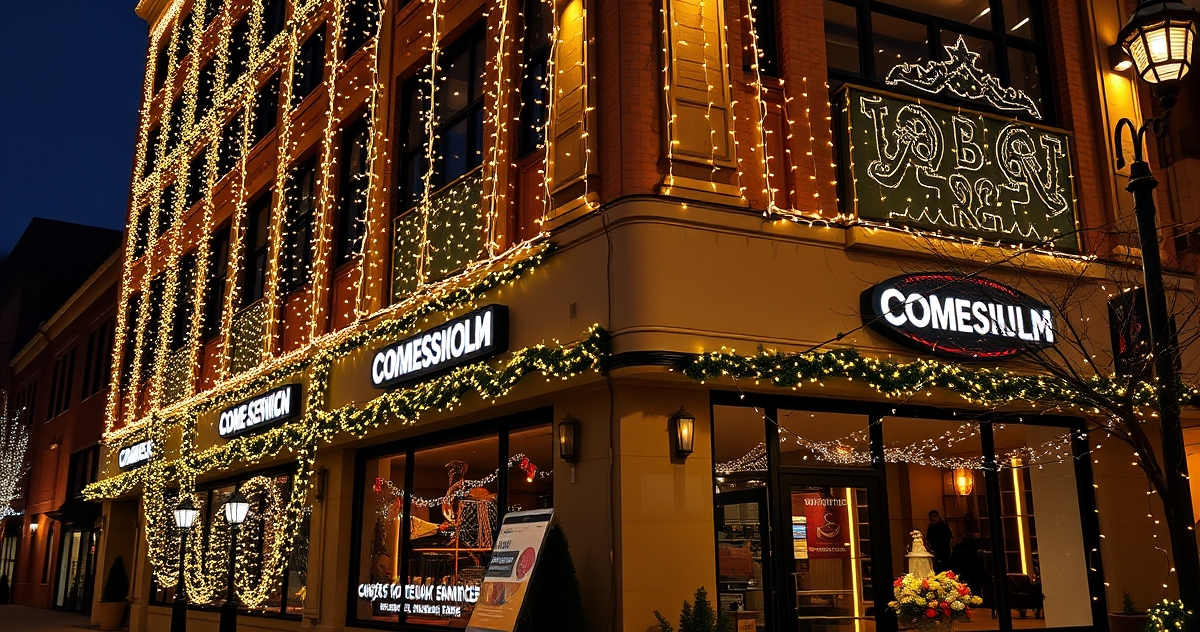
Walk any major Connecticut shopping center in mid-November and you'll spot the difference instantly: some plazas glow with synchronized warm white C9 roofline runs, lush garlands draping every anchor entrance, and giant multicolor bows at every light pole — while others are scrambling with zip-tied strands and a single inflatable. The gap isn't budget. It's timing. The centers that look spectacular every year started planning in July. If your property management team, marketing director, or facilities crew is reading this in the summer, you're in exactly the right place. Here's the complete commercial planning timeline for shopping center holiday lighting in Connecticut, built around the real deadlines, electrical realities, and coordination challenges our crews encounter across the state.
Why July Is the True Starting Line for Connecticut Commercial Holiday Lighting
July is the operational starting line for shopping center holiday lighting in Connecticut because professional installation crews, electrical contractors, and lighting suppliers are fully booked by September — often earlier. Connecticut's commercial lighting season is compressed: towns expect displays to be live by the weekend before Thanksgiving, installations can't happen during peak retail hours in October, and landlord approval chains at larger REITs and property management groups can take six to eight weeks on their own.
There's also a supply reality. C9 commercial-grade bulbs — especially in warm white and multicolor — are manufactured in limited production runs. Custom garland lengths, oversized bows, and pole-mount hardware for parking lot perimeters are often backordered by August. Shopping centers that secure materials and crews in July pay 2025 prices; those who call in October pay rush premiums, if they can find availability at all. Our blog post on planning Christmas lighting installation in summer goes deeper on this dynamic for property owners across the state.
The July–November Planning Calendar at a Glance
- July: Site audit, design concept, landlord pre-approval, and crew booking
- August: Municipal permit applications, electrical load calculations, material orders placed
- September: Final landlord sign-off, tenant communications sent, hardware deliveries received
- October: Phased installation — rooflines, parking lot poles, and anchor tenants first
- Early November: Inline retailer installation, final punch-list, test runs
- Mid-November: Full display live; monitoring and maintenance protocol active
Permit and Landlord Approval Timelines in Connecticut Commercial Zones
Outdoor holiday lighting in Connecticut commercial zones typically requires both landlord written approval and, in many municipalities, a temporary use permit or electrical permit filed with the local building department. Requirements vary meaningfully by town. Greenwich, Stamford, and New Haven have more formalized review processes for large exterior lighting installations than smaller towns, but nearly every Connecticut municipality has zoning language that applies to illuminated decorations on commercial structures — particularly when those displays involve roofline-mounted hardware or wiring to utility panels.
For shopping centers with national or regional anchor tenants (grocery chains, big-box retailers, national apparel brands), expect their corporate facilities teams to require 60–90 days of lead time before approving any exterior lighting plan that touches their lease boundary or façade. Inline retailers in multi-tenant strip centers typically follow the landlord's master plan, but their individual store managers still need written notice and installation scheduling at least 30 days out to avoid conflicts with deliveries, staffing, and loss-prevention protocols.
What Connecticut Municipalities Typically Review
- Electrical permits: Required when display wiring connects to existing commercial panels; a licensed Connecticut EC must pull the permit
- Temporary structure permits: May apply to large pole-mounted bow frames or freestanding display elements above a certain height threshold
- Light trespass and lumen ordinances: Several Fairfield County and New Haven County towns have nuisance-light ordinances; warm white C9 displays typically comply more easily than high-lumen multicolor arrays
- Historical district review: If your center is near or within a Connecticut historic district, additional review timelines apply — see our guide on Connecticut historic districts and modern lighting
Submit permit applications no later than mid-August. That gives municipalities their standard 4–6 week review window and leaves buffer for revision requests before October installations begin.
Calculating Wattage Loads for Large-Format C9 Displays Across Multi-Building Plazas
Wattage load calculation is the most technically demanding aspect of commercial holiday lighting, and it's where under-planned shopping center displays fail most visibly — with tripped breakers, dimming displays, or utility violations mid-season. Commercial-grade C9 bulbs draw approximately 5 watts each for incandescent versions and 0.5–1.5 watts for LED C9s; most Connecticut shopping centers running authentic, high-impact displays use a mix of both depending on zone visibility and circuit availability.
A Working Formula for C9 Roofline Runs
Start with your total linear footage of roofline. A typical 400-foot anchor tenant façade with C9 bulbs spaced 12 inches apart uses 400 sockets. At 5 watts per incandescent C9, that's 2,000 watts (2.0 kW) per façade run — well within a standard 20-amp commercial circuit rated for 2,400 watts. Problems arise when multiple façades, parking lot pole wraps, garland-integrated strings, and entry arch lighting all share the same panel. A 20,000-square-foot shopping center with four façades, 60 parking lot poles, and six entry points can easily require 25–40 amps of dedicated holiday lighting capacity.
| Display Element | Typical Linear Footage | Wattage per Foot (Incandescent C9) | Total Draw |
|---|---|---|---|
| Anchor tenant roofline | 400 ft | 5W/ft | 2,000W |
| Inline retail strip (8 units) | 600 ft | 5W/ft | 3,000W |
| Parking lot pole wraps (60 poles) | 1,200 ft total | 5W/ft | 6,000W |
| Entry garland with integrated lights | 150 ft | 2W/ft (mini lights) | 300W |
| Oversized bows (illuminated, 20 units) | N/A | 15W each | 300W |
| Estimated Total | — | — | ~11,600W |
That's roughly 11.6 kW for a mid-size Connecticut strip center — requiring multiple 20-amp circuits distributed across the property. A licensed Connecticut electrical contractor must verify panel capacity and install dedicated circuits where needed. Attempting to run this load off existing retail circuits causes breaker trips during peak evening hours — exactly when your display needs to be performing. Learn more about electrical planning for exterior commercial lighting in our Connecticut corporate campus exterior lighting guide.
Coordinating Consistent Lighting Across Anchor Tenants, Inline Retailers, and Parking Lot Perimeters
Cohesive holiday lighting across a Connecticut shopping center requires a master design plan that assigns color zones, product types, and installation zones to each property section — agreed upon before any anchor tenant or inline retailer installs a single strand on their own. Without a master plan, you end up with competing aesthetics: one anchor in cool blue LEDs, an inline retailer in multicolor mini lights, and a parking lot perimeter in nothing at all.
The most successful Connecticut commercial displays we install use a two-tier color strategy: warm white C9 runs on all rooflines and building architecture for a unified baseline, with multicolor accents reserved for pole-mounted bows, entry archways, and seasonal focal points like center court displays or main entrance garlands. This approach lets individual tenants feel festive without visual chaos. Our work on coordinated commercial lighting strategies in Connecticut business districts explores this philosophy further.
Products That Unify a Multi-Tenant Display
- C9 bulbs on rooflines: The single most impactful product for commercial exteriors — visible from the parking lot and the road, immediately readable as a professional installation. Warm white C9s create a classic, upscale look; multicolor C9s project energy and celebration.
- Commercial garlands: 8–12 inch diameter mixed pine garlands with integrated warm white mini lights are the workhorse product for anchor tenant entrances, canopy wraps, and leasing office façades. Order custom lengths in July — standard retail garland lengths rarely fit commercial door spans. For tips on keeping garlands looking fresh all season, see our garland maintenance guide.
- Oversized commercial bows: 24–36 inch weatherproof bows in red, gold, or plaid mounted to parking lot light poles are the fastest way to create visual rhythm across a large surface parking area. They read clearly from moving vehicles and require no electrical connection unless internally lit.
- Pole-mount wrap kits: Spiral C9 or mini-light wraps around parking lot poles tie the perimeter to the building display; space them every other pole for economy or every pole for maximum impact.
Tenant Communication Timeline
Send a formal lighting memo to all tenants no later than September 1st. Include: the master color scheme, installation dates and temporary access restrictions, which elements the property will install versus what tenants may install independently, and the removal schedule in January. Tenants who want to supplement with window displays should be directed toward professional window display lighting guidance to ensure their additions complement rather than clash with the center-wide design.
Energy Monitoring and Cost Management for Season-Long Operation
A well-designed Connecticut shopping center display runs from mid-November through early January — approximately 50 nights at 5–7 hours per night. At the wattage levels described above, energy costs matter. Smart timer systems and energy monitoring dashboards allow facilities managers to track consumption by zone, identify outages before tenants notice them, and demonstrate ROI to property ownership. LED C9 conversions — running 0.5 watts versus 5 watts per socket — reduce energy cost by up to 90% on roofline runs while maintaining identical visual impact at street level. For a deeper look at monitoring technology, see our post on energy monitoring for Connecticut holiday lighting.
Build a maintenance visit into your contract — typically one mid-season walkthrough around December 10th to replace burned bulbs, re-secure any weather-loosened garlands or bows, and verify timer accuracy after daylight-saving adjustments. Connecticut's November and December weather — including nor'easters, ice events, and sustained wind from Long Island Sound — puts real stress on exterior displays. Commercial-grade products and professional installation hardware are not optional at this scale; they're the difference between a display that lasts the season and one that becomes a liability.
Booking Your Connecticut Shopping Center Installation
Holiday Lights Decor Connecticut works with shopping centers, strip malls, lifestyle centers, and mixed-use commercial properties across the state — from Fairfield County through the Connecticut River Valley and up to the Quiet Corner. Our commercial holiday lighting services include full design, permit coordination, licensed electrical work, professional installation, mid-season maintenance, and post-season removal and storage. For properties interested in year-round impact beyond the holiday season, ask about our permanent lighting systems that transition seamlessly between seasons.
July bookings receive priority scheduling, first access to material inventory, and the most flexibility in design revisions. August bookings are still viable. By September, crew calendars for October installation windows are typically full.
Frequently Asked Questions
When should a Connecticut shopping center start planning holiday lighting?
Connecticut shopping centers should begin holiday lighting planning in July at the latest. This timeline allows for landlord and anchor tenant approvals (which can take 60–90 days), municipal permit applications (typically 4–6 weeks), material procurement of C9 bulbs, garlands, and commercial bows before fall backorders hit, and crew scheduling before professional installation teams book out for the season. Centers that wait until September routinely face material shortages, permit delays, and rushed installations that compromise quality.
Do Connecticut shopping centers need permits for outdoor holiday lighting?
Most Connecticut shopping centers require at least an electrical permit when holiday lighting connects to existing commercial panels, and many municipalities require a temporary use permit for large-scale exterior displays. Requirements vary by town — Stamford, Greenwich, and New Haven have formal review processes, while smaller towns may require only a licensed electrician to pull an electrical permit. Historical district proximity can add additional review layers. Always submit applications by mid-August to allow for municipal review before October installations.
How do you calculate the wattage needed for C9 displays across a large shopping plaza?
Calculate wattage by multiplying total socket count by watts per bulb: incandescent C9 bulbs draw approximately 5 watts each; LED C9s draw 0.5–1.5 watts. A 400-foot façade with C9 bulbs at 12-inch spacing uses 400 sockets — 2,000 watts (incandescent) or 200–600 watts (LED). For a full shopping center with multiple façades, parking lot poles, garlands, and illuminated bows, total draw often reaches 10,000–15,000 watts, requiring multiple dedicated 20-amp circuits. A licensed Connecticut electrical contractor must verify panel capacity and install dedicated circuits as needed.
What's the best way to create a cohesive look across multiple tenants in a shopping center?
The most effective approach is a two-tier color strategy: warm white C9 roofline runs on all building façades create a unified baseline visible from the parking lot and the road, while multicolor accents on pole-mounted bows, entry garlands, and focal point displays add energy and celebration without visual chaos. Distribute a master lighting plan to all tenants by September 1st, specifying which elements the property installs, what tenants may supplement independently, and the removal schedule. Consistent product types — matched garland diameters, identical bow sizes — matter as much as color coordination.
What products are most impactful for Connecticut commercial shopping center displays?
The three highest-impact products for Connecticut shopping center displays are commercial-grade C9 bulbs on rooflines (warm white for elegance, multicolor for festivity), mixed pine garlands with integrated warm white mini lights at anchor entrances and canopy wraps, and oversized 24–36 inch weatherproof bows on parking lot light poles. These products are visible from the road and parking lot at scale, durable through Connecticut's November–January weather, and create the visual rhythm that distinguishes a professional installation from a retail-store display.
Can Holiday Lights Decor Connecticut handle permit coordination for shopping centers?
Yes. Holiday Lights Decor Connecticut's commercial services include full permit coordination — we work with your property management team and local Connecticut municipalities to identify required permits, prepare application documentation, coordinate with licensed electrical contractors for panel work, and manage the approval timeline so installations stay on schedule. Our team is familiar with commercial zoning requirements across Fairfield, New Haven, Hartford, Middlesex, and Tolland counties. Contact us at our contact page to begin the planning process for your property.
Ready to get your Connecticut shopping center on the holiday lighting calendar before the rush? Contact Holiday Lights Decor Connecticut today for a free commercial estimate — our July planning slots fill quickly, and locking in now is the single best decision you can make for a stunning, stress-free holiday display season.